
Comprehensive Plans
“Duos insequens lepores, neutrum capit" (He who chases two hares catches neither).
Desiderius Erasmus, in Adagia
The meaning of the quote above, and many others like it, is that trying to do everything usually leads to completing nothing. This is the way I have felt about comprehensive plans for the better part of the last four decades. They are essentially giant buckets of information that are complicated, vague, and without implementation structure.
Everything is Nothing
But they don’t have to be.
At the heart of the comprehensive plan is the idea that planners can know, and fix in a document, the future of the city (or village, county, borough, even country) through the creation of a Future Land-Use Plan (more on that here). This strategy is flawed because it employs one of the most impermanent and unknowable elements of cities, the future use of land, to drive everything else. In fact, if you scroll through the myriad RFP’s for Comprehensive Planning projects, you will find that most focus on efforts such as ‘updating the 10-year land-use plan’ as the main driver or critical component of the effort. The challenge this creates is illustrated by the words used; comprehensive – everything, and plan – project the future. Planners are being asked to accurately predict the future and then use that prediction to determine every other aspect of the future of the city: infrastructure, transportation, utilities, economic development, services, etc. This is simply impossible.
The current process is ostensibly organized around a vision, prepared for the Plan, that is almost always the result of a public engagement process that asks a few overly simplistic and broad questions and results in a series of predictable goals: safe cities, neighborhood stability, reduced traffic, vibrant downtowns, economic growth, etc. Of course everyone wants these things, but getting them is complicated, and it requires rigorous evaluation and management. Cities are constantly changing, and with these changes (planned or un-planned), the context for implementation changes. To address this, we should be looking at comprehensive planning as a more fluid effort, something I would call comprehensive management. We shouldn’t stick to a path, or even a vision, if it isn’t working. We should be able to make adjustments in the plan that course correct those implementation strategies that aren’t working. The way to do this is measure impact; impact from a baseline, and impact towards a target.
In a simplified explanation, this means we use a more objective method for planning and managing the transformation of cities (growth and contraction), based on alignment of policies with expected, or desired, impact. The diagram below illustrates how this might work (note, the exact structure isn’t as important as the idea that whatever program is used, it’s fluid, adaptable, and based on clearly understood metrics):
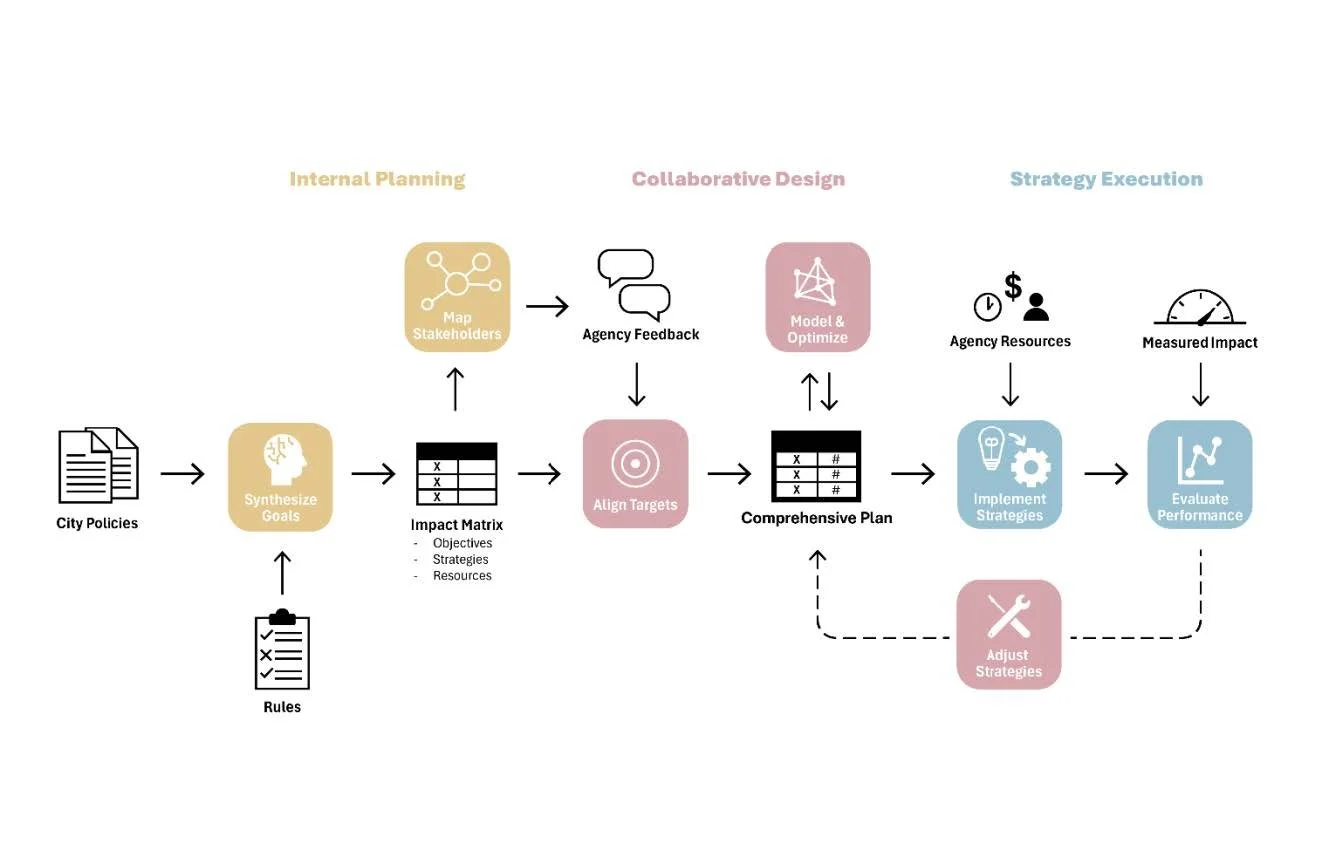
Methodology Diagram
To facilitate this, the following process might be used:
Identify all current policies, prioritize, and refine.
Identify strategies for prioritized policy implementation (can be multiple for each policy).
Set the metrics for evaluation and tracking (inputs, outputs, outcomes, and impacts).
Prepare scenarios for implementation, which provide baseline and target metrics.
Measure progress.
Adjust when necessary.
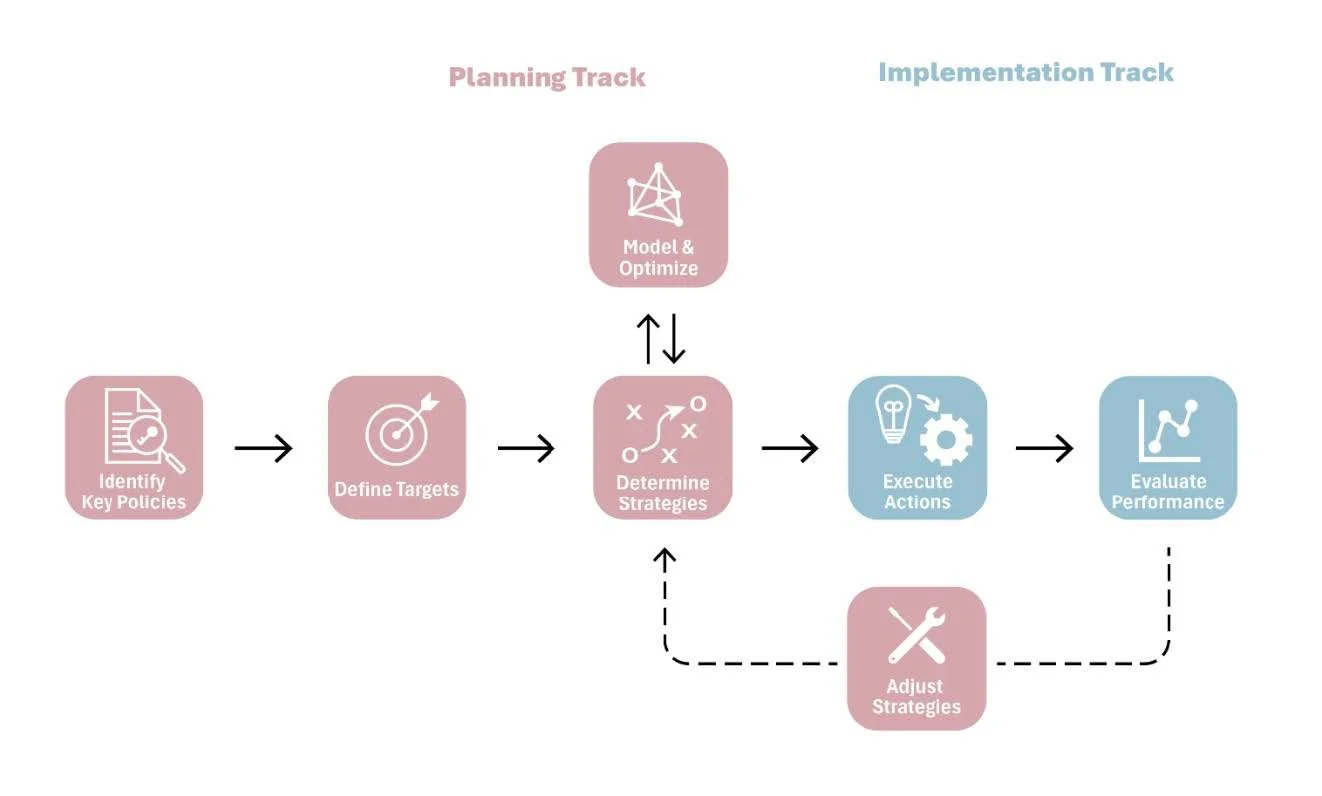
Review and Adjustment Process
The key to this is understanding the desired impact we want to make on the community, tracking progress, and most importantly being open to adjustments when we realize our efforts aren’t getting us closer to our goals. This means we must embrace being wrong, when we are wrong.
One last note on this: the community engagement process. As outlined above, the community engagement process isn’t about getting the community’s vision for its future, at least not only that. Setting up this method allows the community to engage with a much higher degree of transparency. All efforts require trade-offs. Funding isn’t infinite, policies working at cross purposes can have unintended negative outcomes. But by bringing a model that clearly demonstrates the impact of those trade-offs, the broader community can help make decisions in a more informed way, and they will better understand the tradeoffs that need to be addressed as the city moves through implementation. And maybe most importantly, the community can see how well initiatives, projects, and programs are performing.
Comprehensive plans are a kind of commodity, and they have been for decades. But the tide is turning, and hopefully they will transform into something that is more useable, adaptable, and has a significant, positive impact on the cities that adopt them.